A Technical Overview for Orthodontists and Orthodontic Technicians
Introduction
Conventional orthodontic brackets have long followed a « standardized, mass-produced » model: the same torque, angulation, and in-out prescription is applied to every patient, requiring the clinician to compensate for individual tooth anatomy through wire bending and repeated adjustments. In recent years, the maturation of digital scanning, CAD/CAM design, and 3D printing has moved the concept of a « bracket designed specifically for each tooth » from theory into commercial products. This article summarizes the two main customization approaches currently on the market and the role 3D printing plays in each, as a reference for clinical practice.
- Two Technical Approaches to Customization
Custom bracket systems on the market today generally fall into two technical logics. Both require digital intraoral scanning and treatment-planning software, but they differ in where the customization actually happens.
Approach 1: Standard Bracket Body + Custom Slot Milling (represented by Ormco Insignia)
Ormco’s Insignia system represents this approach, with a workflow generally summarized in four stages:
- Scan: An intraoral scanner captures a digital model of the patient’s dental arch.
- Design: A technical team produces an initial digital setup; the clinician reviews and adjusts the final occlusal endpoint (T2) using Approver software. Once approved, the system calculates individualized torque, angulation, and in-out values for each tooth.
- Build: The bracket body itself remains a standard injection-molded 17-4 stainless steel appliance. Customization is applied by CNC-milling the slot according to the calculated prescription, while a robotically bent custom archwire and clear indirect-bonding jigs are also produced.
- Bond: The clinician or assistant uses the custom jig for precise, single-step bonding.
The defining feature of this approach is that the bracket « substrate » is not individually 3D printed; customization is expressed mainly through slot angulation and wire bending. This is a mature, long-established technology with decades of clinical data behind it.
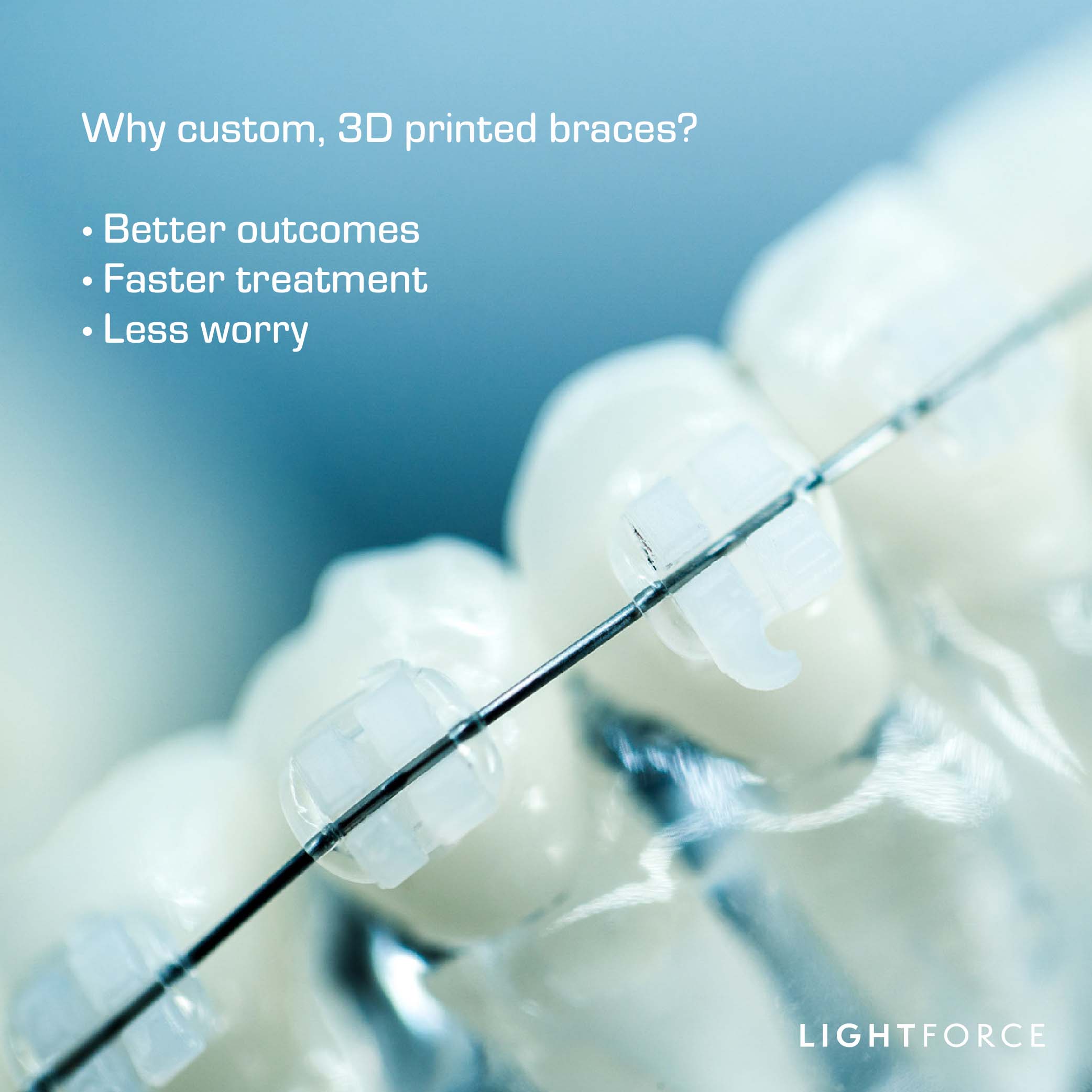
Approach 2: Fully 3D-Printed Brackets (represented by LightForce)
LightForce’s approach generates and prints the base geometry of each bracket individually, according to the anatomy of each tooth, eliminating the need for a custom archwire since first-, second-, and third-order prescription values are already built into the bracket’s three-dimensional shape. This approach currently has two parallel material/process tracks:
| Product | Material | Printing Technology | Launch |
| Ceramic bracket (flagship product) | Polycrystalline alumina ceramic | Light-based 3D printing (DLP/SLA-type) | 2019 (FDA cleared, US) |
| LightBracket Metal | Metal alloy | Metal 3D printing (specific process undisclosed) | 2026 (launched in the US, unveiled at the AAO annual session) |
- Technical Challenges of Metal 3D-Printed Custom Brackets
Compared with the ceramic light-based printing approach, which has been validated over several years, metal 3D-printed custom brackets are still in an early commercialization stage. The main challenges fall into four areas:
- Precision and post-processing burden Metal 3D printing (whether selective laser melting, direct metal laser sintering, or binder jetting) typically produces parts with rough surfaces. Critical geometries such as the slot, which require micron-level tolerances, generally need secondary precision machining and polishing to ensure smooth wire sliding and accurate force transmission.
- Biomechanical validation threshold Brackets must withstand long-term occlusal forces, wire friction, and repeated bonding/debonding stress. If internal density, grain structure, or residual stress in metal-printed parts are not well controlled, fatigue strength and corrosion resistance may be affected — requiring more extensive fatigue and material validation data than conventional forged or injection-molded stainless-steel brackets.
- Yield and quality control for piece-by-piece customization Each bracket base geometry is unique, so it cannot be mass-produced with fixed parameters the way standardized products are. Every unit must be individually laid out and individually inspected, making yield control and production scale-up more difficult.
- Regulatory validation complexity Under FDA and EU MDR frameworks, piece-by-piece customized medical devices typically require additional proof of process consistency — meaning batch-level material certification and process validation requirements are more demanding than for standardized products. This is one reason commercialization of this technology has been slower.
- Market Status Summary
- United States: LightForce’s LightBracket Metal was formally launched and publicly unveiled in the US in 2026, extending « full customization » from ceramic brackets — historically a niche segment — into the metal bracket market, which roughly 65% of patients worldwide choose.
- Europe / France: As of now, there is no publicly available information indicating that LightForce has a CE mark, an authorized representative, or a distribution channel in the EU or France. The product line still appears to be US-focused and has not yet entered the EU market in parallel. Ormco Insignia, by contrast, already has a European website and product line and is an established, distributed system in Europe.
- Mainland China: Chinese manufacturers currently focus their commercial efforts in 3D-printed orthodontics primarily on clear aligners (e.g., Angelalign, Invisalign-type competitors), with relatively few commercialized cases of 3D-printed custom brackets themselves. Most activity comes from dental 3D printing equipment/material suppliers (e.g., LuxCreo) providing technology to dental labs for custom base fabrication; no bracket brand at LightForce’s scale has yet emerged.
- Reference Clinical Outcome Data
Based on publicly available manufacturer materials and related literature, custom 3D-printed bracket systems have shown, in some studies:
- Compared with conventional bracket systems, up to 60% fewer appointments, up to 43% shorter treatment time, and up to 70% fewer adjustments (data cited from clinical journals referenced by the manufacturer; actual results vary by clinician and patient case).
- A 2026 systematic review analyzing six related studies found that 3D-printed brackets generally achieve clinically acceptable slot dimensions, in some comparisons even outperforming conventional metal, ceramic, and self-ligating brackets in dimensional accuracy — though surface roughness was generally higher, with performance varying by printer type, material, and post-processing.
- A 2026 retrospective study of 94 patients found average treatment duration of 15.89 months for custom 3D-printed brackets, 14.39 months for clear aligners, and 27.79 months for conventional brackets.
The above data is for reference only; actual clinical decisions should be based on individual case assessment, complete manufacturer technical documentation, and local regulatory approval status.
- Key Considerations for Clinical Practice
When evaluating whether to adopt a custom 3D-printed bracket system, orthodontists and technicians may wish to consider:
- Definition of customization: Does the manufacturer’s claim of « customization » mean the bracket body itself is newly designed and printed, or a standard body with custom slot milling? These differ fundamentally in treatment logic (whether a custom archwire is still required) and in the operational workflow.
- Material and regulatory status: Metal 3D-printed brackets are a relatively new technology; local regulatory approval status and classification (e.g., EU MDR, Taiwan TFDA, China NMPA) should be confirmed.
- Supply chain and lead times: Piece-by-piece custom production generally has a longer lead time than stocked standardized brackets, which should be factored into patient scheduling.
- Digital workflow integration: Custom systems typically require specific intraoral scanners and software platforms; compatibility with the existing clinic digital workflow should be assessed before adoption.
This article is compiled from publicly available industry information and manufacturer materials. It is intended for technical awareness and reference only, and does not constitute procurement or regulatory advice. Actual adoption decisions should be based on the latest official technical documentation and local regulatory requirements.